Book Club: The Artificial Silk Girl
with Professor Uca Didem

- Date/Time
- –
- Format
- Online
- Admissions
- General: Free
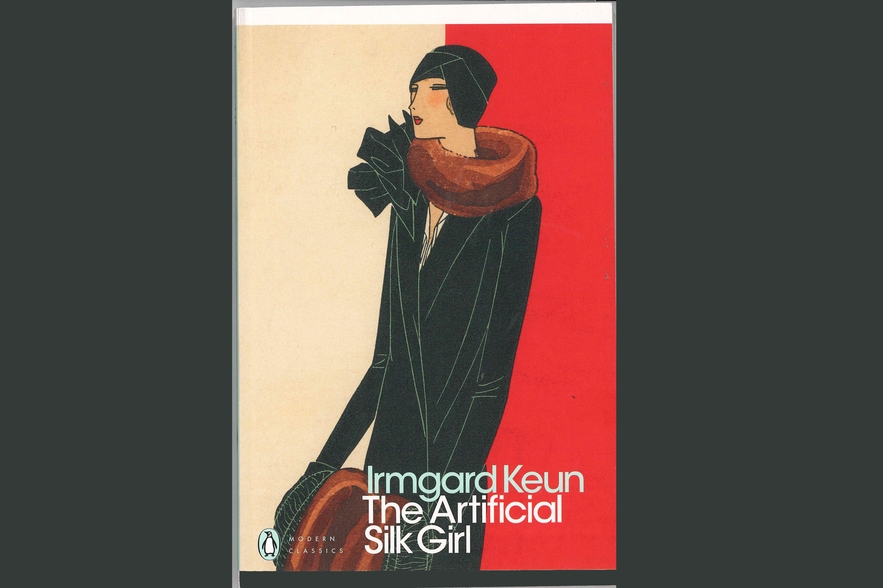
Professor Didem Uca will join LBI to discuss The Artificial Silk Girl
This enthralling tale of a “material girl” in 1930s Berlin is the masterpiece of a literary icon, rediscovered and restored to the same heights as such luminaries as Isherwood and Brecht.
In 1931 a young woman writer living in Germany penned her answer to Anita Loos’s Gentlemen Prefer Blondes and the era of cinematic glamour: The Artificial Silk Girl. Though a Nazi censorship board banned Irmgard Keun’s work in 1933 and destroyed most existing copies, the novel survived, as fresh and relevant today as the day it was written.
The Artificial Silk Girl is the story of Doris, beautiful and striving, who vows to write down all that happens to her as the star of her own life story. But instead of scripting what she hopes will be a quick rise to fame and fortune as either an actress or the mistress/wife of a wealthy man, she describes a slow descent into near prostitution and homelessness. Prewar Berlin is not the dazzling and exciting city of promise it seems; Doris unwittingly reveals a bleak, seamy urban landscape.
(Description: Penguin Random House).
Author Irmgard Keun
Irmgard Keun (1905 – 1982) was a (non-Jewish) German novelist. She is noted for her portrayals of the life of women in the Weimar Republic as well as the early years of the Nazi Germany era. She was born into an affluent family and was given the autonomy to explore her passions. After her attempts at acting ended at the age of 16, Keun began working as a writer after years of working in Hamburg and Greifswald. Her books were eventually banned by Nazi authorities but gained recognition during the final years of her life. She was a romantic partner to the Jewish author Joseph Roth.
About Our Guest

Didem Uca is Assistant Professor of German Studies and associated faculty in the Departments of Women’s, Gender, and Sexuality Studies and Middle Eastern and South Asian Studies at Emory University. With a focus on intersectional approaches to post/migration cultures, Dr. Uca’s research has appeared in journals including Gegenwartsliteratur, Die Unterrichtspraxis / Teaching German, Seminar, and Monatshefte, for which she wrote about how the protagonist of Irmgard Keun's novel Child of All Nations can be interpreted as an adaptation of the character of Mignon from Johann Wolfgang von Goethe's Wilhelm Meister's Apprenticeship. As a literary translator from German and Turkish, her work has appeared in venues such as TRANSIT, Konturen, SAND Journal, and Turkish German Studies. A dedicated pedagogue, Dr. Uca's teaching has been honored with the Goethe-Institut/American Association of Teachers of German Certificate of Merit (2020) and the American Council on the Teaching of Foreign Languages German Special Interest Group's Early Career Award (2024).