An Opera Visit with Franz Kafka
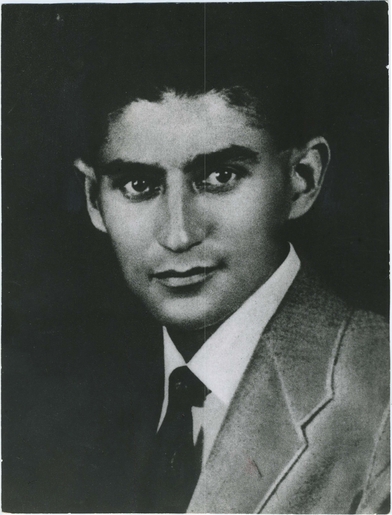
LBI Archives, AR 1429, Photo Collection, F 2258.
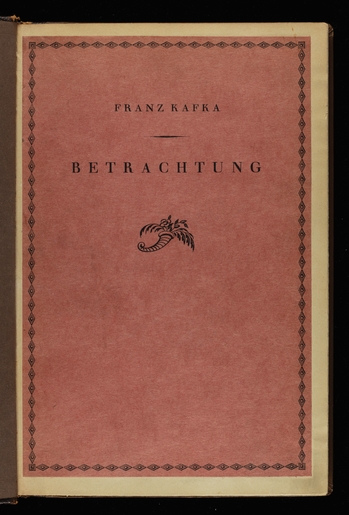
Franz Kafka: Betrachtung. Leipzig: E. Rowohlt, 1913. No. 162 of 800 published copies.
LBI Library, r PT 2621 A26 B4.
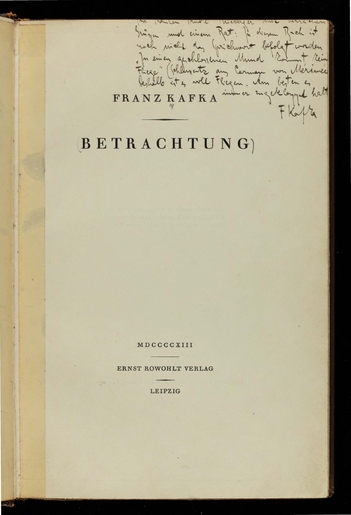
Franz Kafka: Betrachtung. Leipzig: E. Rowohlt, 1913.
LBI Library, r PT 2621 A26 B4.
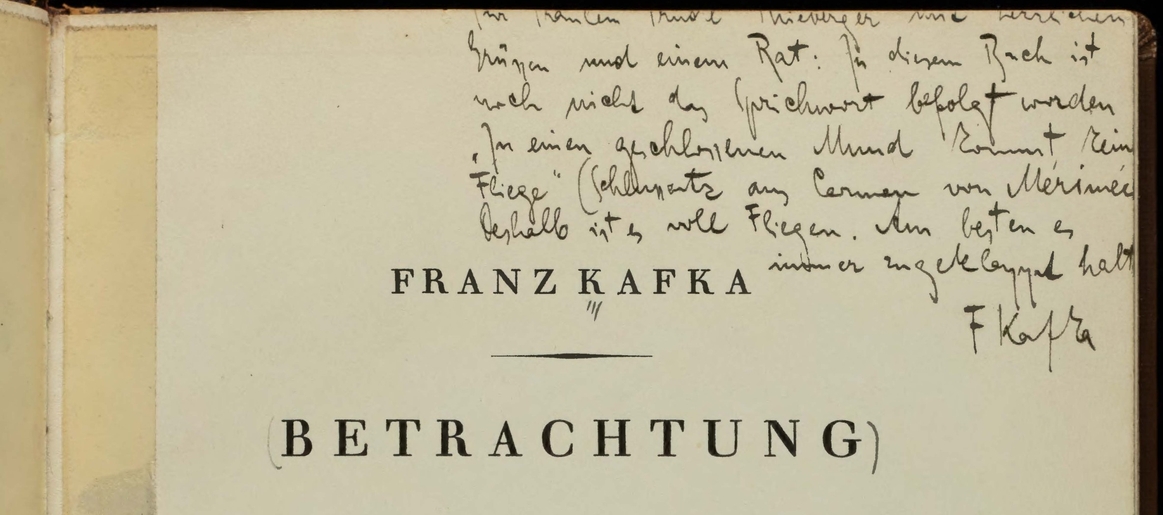
Translation: "For Miss Trude Thieberger with warm regards and a piece of advice: In this book, the saying “A closed mouth catches no flies” (the closing line from [Prosper] Mérimée’s Carmen) has not yet been followed. Therefore, it is full of flies. Best to always keep it closed. F. Kafka."
Franz Kafka: Betrachtung. Leipzig : E. Rowohlt, 1913.
LBI Library, r PT 2621 A26 B4.
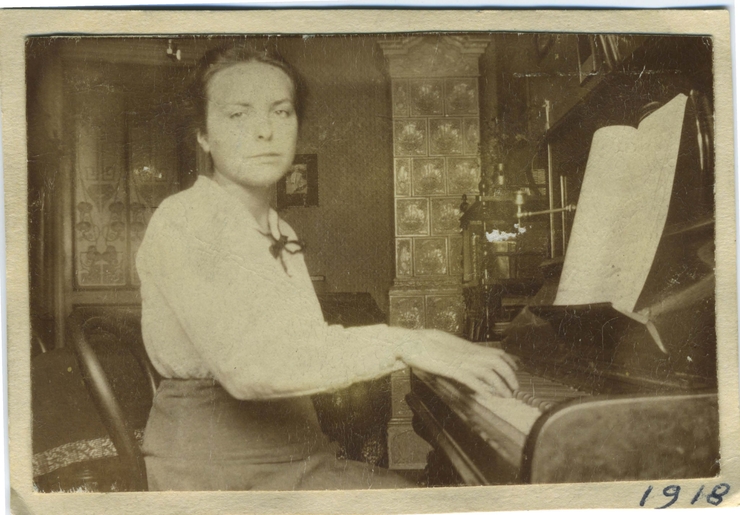
LBI Archives, AR 7110, Photo Collection, F 11232.
Gertrude Urzidil’s Signed Copy of Kafka’s First Book
A copy of Franz Kafka’s first published book, Betrachtung (Meditation), personally inscribed to the poet Gertrude Urzidil, is both a rare bibliographic object and a record of lived literary history. Preserved by the Library of the Leo Baeck Institute, the volume reflects the dense networks of friendship, creativity, and displacement that shaped German-speaking Central European culture in the early twentieth century.
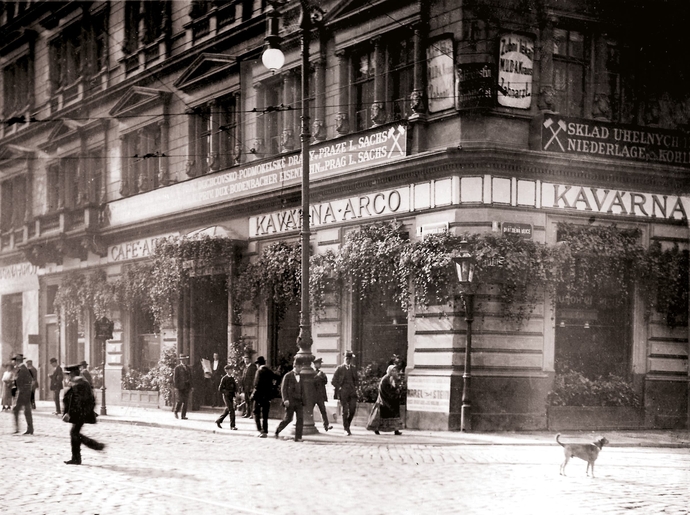
Prague and Café Arco
Gertrude (Trude) Urzidil, née Thieberger (1898–1977), was a German-speaking poet from Bohemia who participated in Prague’s vibrant post–World War I literary scene. Writers such as Franz Kafka, Max Brod, and Franz Werfel gathered regularly at Café Arco, a central meeting place for young German-speaking artists and intellectuals. In this milieu, personal encounters and literary production were closely intertwined.
In later life, Gertrude Urzidil recalled her early meetings with Kafka as a series of casual but memorable moments: encounters on Prague’s old streets, shared attendance at Max Brod’s lectures, and walks home through nearby neighborhoods. Her recollections present Kafka not yet as a canonical author, but as a respected and slightly enigmatic figure within a small and familiar circle.
A Book as a Gift
One such encounter led to an invitation to attend the opera Carmen at the Prague Theater. Instead of the customary sweets, Kafka presented the young Gertrude with his newly published Betrachtung, published in 1913, adding a playful and ironic dedication, that also alluded to the literary source of the famous opera: Bizet’s celebrated 1875 Carmen is based on the 1845 novella by Prosper Mérimée.
Kafka’s inscription to Gertrude (Trude) Urzidil (née Thieberger) reads:
Für Fräulein Trude Thieberger mit herzlichen Grüssen und einem Rat: In diesem Buch ist noch nicht das Sprichwort befolgt worden "In einem geschlossenen Mund kommt keine Fliege" (Schlusssatz aus Carmen von Mérimée). Deshalb ist es voll Fliegen. Am besten es immer zugeklappt halten. F. Kafka.
Translated:
For Miss Trude Thieberger with warm regards and a piece of advice: In this book, the saying “A closed mouth catches no flies” (the closing line from [Prosper] Mérimée’s Carmen) has not yet been followed. Therefore, it is full of flies. Best to always keep it closed. F. Kafka.
The dedication captures Kafka’s characteristic self-irony and points to a personal relationship that extended beyond formal literary acquaintance.
Preserving Cultural and Literary Memory in Exile
In 1922, Gertrude married the poet and writer Johannes Urzidil (1896–1970). After the Nazi occupation of Czechoslovakia in 1939, the couple fled into exile and settled in New York in 1941. There, Gertrude lectured on literature and supported the family, while Johannes worked for the Voice of America. Like many émigré intellectuals, they preserved their cultural world through books and memory.
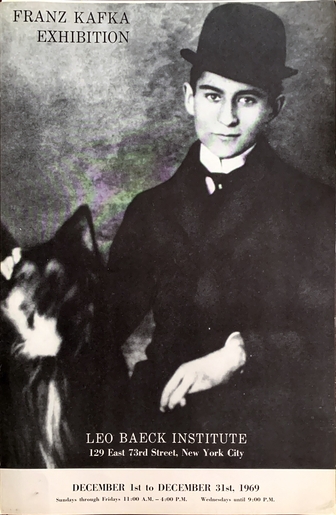
Gertrude Urzidil’s signed copy of Betrachtung traveled with her across continents and decades. In 1969, she lent the volume to the Leo Baeck Institute for its inaugural Kafka exhibition. She later donated the book, along with the Urzidils’ extensive literary library, to the Institute.
A Book’s Journey
Within LBI's Book Journeys and Cultural Memory series, this volume exemplifies how books carry personal histories across time and place. Kafka’s first book, inscribed to a young poet in Prague, survived exile and migration to become part of a public collection. Its trajectory reflects the experiences of its owners and preserves the memory of a literary world disrupted but not erased.
*Source: Gertrude Urzidil, “My Personal Meetings with Franz Kafka,” Journal of Modern Literature 6, no. 3 (1977): 446–47.