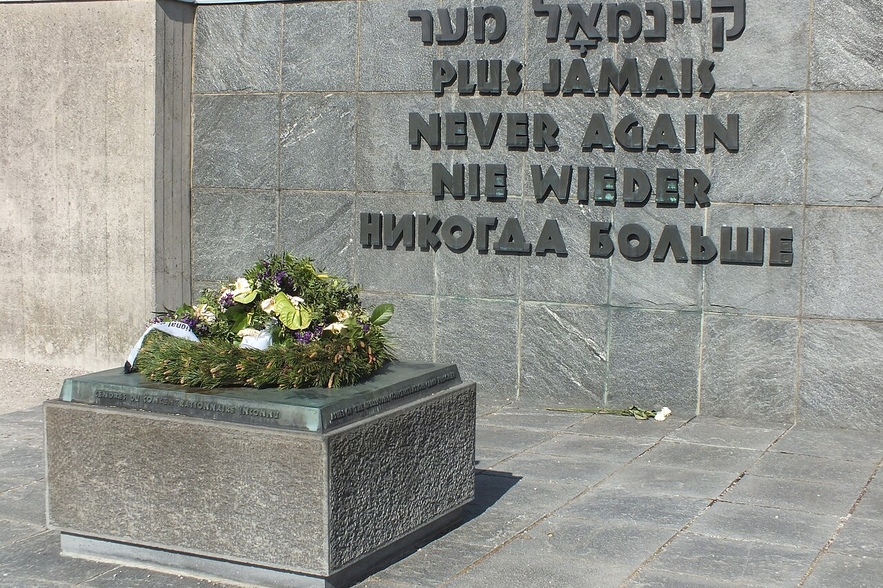
Never Again, When?: German Memory Culture, the Holocaust, and Free Expression
with Irit Dekel and Omri Boehm
- Date/Time
- –
- Venue
- Center for Jewish History (map)
15 W. 16th St.
New York, NY 10011 - Format
- In person
- Admissions
- General: Free
This event is part of LBI's Forum on Free Speech and Democracy.
In a recent article for New German Critique, sociologist Irit Dekel (Indiana University, Bloomington) described the phrase “Never Again” as a floating signifier, “flexible enough to carry different meanings for different audiences while remaining specific enough to galvanize various political actions, depending on the context and speakers.” In a comprehensive analysis of the use of the phrase in German discourse since October 7, 2023, she showed how “Never Again” has been deployed to argue for the singularity of the Holocaust and the need to protect Jews from a feared repetition of the catastrophe. When the same language is invoked to draw universal lessons from the Holocaust, however, it can draw both social and legal censure.
With philosopher Omri Boehm (The New School), Dekel will discuss the origins of the phrase “Never Again” in German history and the ways that Holocaust memory politics impacts free expression in Germany today.
About the Series: Leo Baeck Institute Forum on Free Speech and Democracy
Made possible in part by support from the Erna & Heinz Mayer Fund at the LBI
As the United States observes its semiquincentennial anniversary, one of its most cherished political values is also one of its most hotly debated. Is free speech still protected in America? If not, what poses the greater threat: state repression, a censorious culture, or a corporate media environment where free expression belongs to the highest bidder? In a world where hatred quickly metastasizes online – are the people even safe from free speech?
The ideas that found expression in the First Amendment and the constitutions of other liberal democracies were shaped and reshaped by Jewish thinkers from Spinoza to Arendt, enabled processes of Jewish emancipation and religious reform, and are still seen as undergirding religious freedom in pluralistic societies.
In this series, scholars, activists, and public intellectuals will explore these questions through the lens of German-Jewish history, starting with documents in the LBI collections and mining them for insight into the present.
Irit Dekel is an Assistant Professor in Germanic Studies and Jewish Studies at Indiana University Bloomington. Her work focuses on the relations between collective memory, media and the public sphere, particularly on Holocaust memorialization and the representation of ethnic and religious difference in contemporary Germany. Dekel’s first book, Mediation at the Holocaust Memorial in Berlin (Palgrave, 2013), analyzed how various groups mediate their experience in the Holocaust Memorial. Her second book, ‘Witnessing Positions: Jews, Memories and Minorities in Contemporary Germany’ is forthcoming with Indiana University Press in January 2027. Dekel co-edited the Routledge Handbook of Memory Activism (2023).
Omri Boehm is Associate Professor and Chair of Philosophy at the New School for Social Research. He teaches and writes on early modern philosophy and philosophy of religion, with a specific focus on Descartes, Spinoza and Kant. His books include The Binding of Isaac: A Religious Model of Disobedience (Continuum, 2007), Kant’s Critique of Spinoza (Oxford University Press, 2014), Haifa Republic: A Democratic Future for Israel (Penguin Random House, 2021), and Radikaler Universalismus: Jenseits von Identität (Propyläen Verlag, 2023). In addition to his academic publications, he has also written for outlets including the LA Review of Books and the New York Times.
Upcoming Events
–
–
–

–
–
–

–