Donate Historical Materials
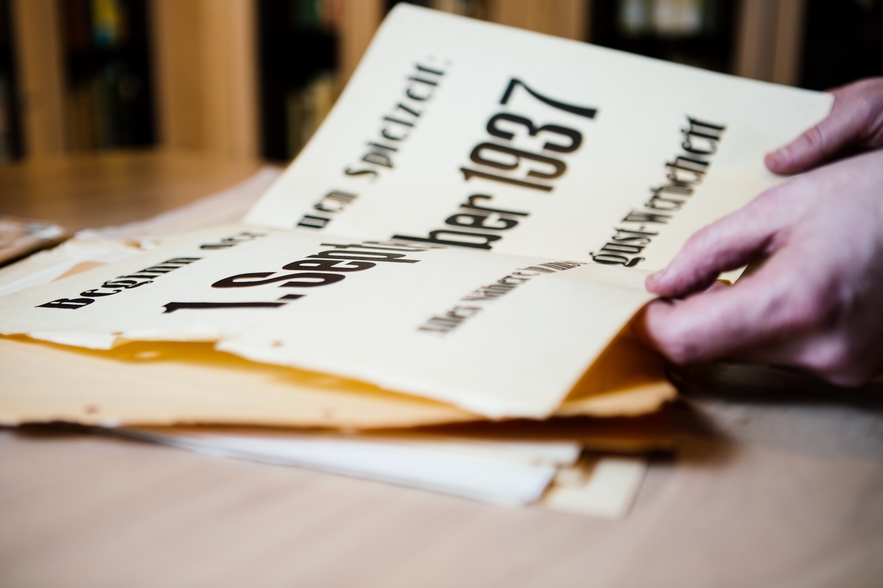
Our collections are at the heart of our mission to preserve the German-Jewish past and to keep that past present for future generations. The majority of the collections were entrusted to LBI by individuals, families, and organizations seeking a safe permanent home for materials they had saved from destruction and plunder in Europe. Even seven decades after the founding of LBI, new materials are still being discovered, and we welcome donations of books, archival materials, art, and objects related to German-Jewish history.
In our facilities at the Center for Jewish History (CJH) in New York, donated materials are physically preserved, processed, cataloged, and digitized according to best practices. Most importantly, they remain accessible to future generations and are situated in the context of German-Jewish history and the global Jewish history represented by our partners at the CJH.
Archival Materials
The Archives of the Leo Baeck Institute (LBI) collects documents and artifacts of German-speaking Jewish life and culture from throughout the long history of German-speaking Jews in Central Europe and in the diaspora. The Archives seeks not only to collect and preserve materials related to well-known personalities, but accepts material from any and all individuals, families, communities, and businesses of German-Jewish origin. The Archives collects, arranges, describes and preserves this material, and provides researchers and visitors with access to it, especially through comprehensive digitization of archival holdings.
The goal of the Leo Baeck Institute is to continue to expand its existing archival collections. The next few years will be decisive in this regard. The LBI calls upon all German-Jewish immigrants and their descendants to consider donating letters, photographs, correspondence, memoirs, manuscripts, ephemera, photos, and other unpublished materials pertaining to their family history. The LBI, in turn, will carefully care for and preserve these materials as described in our ARCHIVAL DONATIONS - CARE AND PROCESSING GUIDE, so that they will serve as a research and information resource on German-Jewish history for future generations. See also ARCHIVAL DONATIONS - CARE AND PROCESSING FAQs
If you are interested in donating materials, please contact Renate Evers, Director of Collections.
A Note Regarding Hazardous Materials in Collections
Please note that we are unable to accept materials that pose safety or health risks. This includes, but is not limited to:
- Flammable or combustible items (e.g., Nitrate Film (Cellulose Nitrate), Acetate Film (Cellulose Acetate)
- Biohazardous materials (e.g. medical equipment, artifacts treated with pesticides)
- Items affected by mold, pests, or other conditions that could endanger staff, visitors, or other collection materials
We appreciate your understanding and encourage donors to contact us before bringing items to discuss their suitability. This ensures the safety of everyone and helps us maintain the integrity of the collection.
A Note Regarding Digitized Material & "Born Digital Collections"
The Leo Baeck Institute is receiving a significant number of donations which are digitized scans of items and objects or only available in digital form. Please know that despite their being in digital form, it takes just as much time to go through the workflows required to process any collection material, and thus donating digital material does not mean that it will more quickly appear in our catalog and on our website. Whether physical or digital, collections are processed in the same manner for the creation of a finding aid, following current archival standards of arrangement. It is necessary to organize any information donated to our Institute in such a way that the file naming conventions and file formats follow our database systems and professional protocols, details see our ARCHIVAL DONATIONS - DIGITAL COLLECTION DONATION GUIDELINES. When this process is followed, it makes access to the donated digital collection more streamlined and easier to navigate.
A Note Regarding Research Files and Scholarly Estates
The Leo Baeck Institute (LBI) collects and preserves materials documenting the history and culture of German-speaking Jewry. Our primary collecting priority is family and personal collections containing unique original materials, which often have no other suitable repository.
Research files and scholarly estates, particularly large academic collections, present significant challenges in terms of processing, staffing, storage, and digitization. Such collections are often better suited to university or academic archives, which are specifically equipped to manage large-scale scholarly papers and where researchers typically expect them to be housed.
LBI will consider accepting scholarly estates only when no other appropriate repository is available and when the collection clearly aligns with our mission.
Because of their size and complexity, large scholarly estates are generally accepted only with accompanying external funding to support processing and, where applicable, digitization. Without such funding, processing and access may be significantly delayed, and digitization may not be feasible.
All proposed donations are reviewed on a case-by-case basis, taking into account collection scope, institutional capacity, and existing priorities.
Library Books & Periodicals
The Library of the Leo Baeck Institute (LBI) welcomes donations of books that fall within the scope of our Library Collection Development Policy. The LBI library focuses on the following major subject categories: historical, philosophical, religious, social, cultural, political, and economic expressions of the German-Jewish tradition as well as books by German-speaking Jewish authors. The time frame of the collection extends from the beginning of the German-Jewish settlement to the present. The main languages of the collection are German and English, with a lesser emphasis on Hebrew. Other languages are added if they fall within the subject scope on a selective level. Translation from German into English or from other languages to either English or German are collected selectively.
As of 2019, The LBI Library will only accept
- Books within our collection scope that are not yet part of the library collection, no duplicates will be accepted;
- Books with relevant inscriptions or other strong connections to archival collections. These books will remain with the archival collections.
In order to ensure that your book donation will become a treasured addition to our library collection, please send a list of book title you are planning to donate to Renate Evers, Director of Collections.
Art & Objects
The Art and Objects collection of the Leo Baeck Institute reflects the multi-faceted legacy of German-speaking Jewry. Paintings, drawings, prints, bookplates and objects document the rich material culture that is part of our heritage. Our goal is to present the legacy of Central European Jews in all its facets, including the role of Jews as creators of art, music, fashion, design, architecture, and the crafts.
Donated artwork must be relevant to the Institute’s mission, and prospective donors should submit the following information.
- Contact information
- Artist/maker, title, medium dimension of the work, year of creation
- Description of artwork or object
- Provenance information
- Photo of item to be donated
All donations are permanent, and must be in good (i.e., exhibition-ready) condition. If a donor is willing to contribute financially to the preservation of an item, exceptions might be made.
Donated items become the property of the Leo Baeck Institute, to be displayed, stored, loaned, or, in rare instances, deaccessioned at the discretion of the Institute.
At this time, due to space and staffing limitations, the Leo Baeck Institute is NOT able to accept the following (though exceptions might be made, up to the discretion of LBI staff):
- large single artworks (such as sculptures or heavy, framed paintings)
- large single objects (such as furniture)
- large collections of artworks (such as entire oeuvres by a single artist)
- large collections of family heirlooms (such as flatware sets or teaware sets)
- textiles, linens, garments, or costumes
If you would like to donate a work of art to the Leo Baeck Institute, please contact Renate Evers, Director of Collections and Lauren Paustian, Registrar & Collections Care Manager