Incunabula in the LBI Library
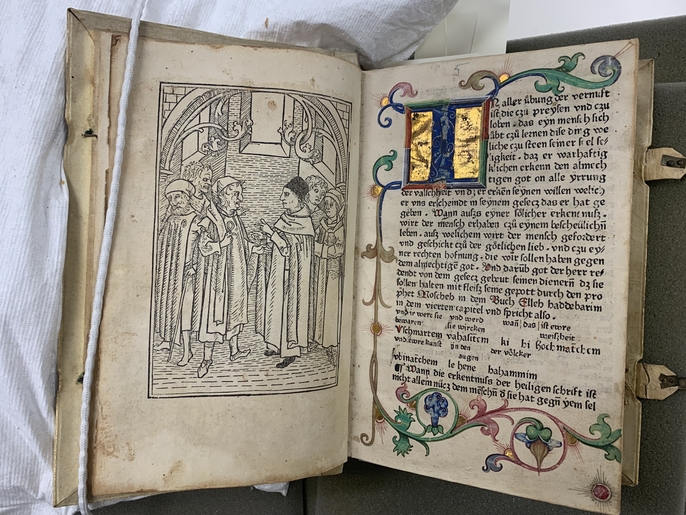
Petrus Nigri: Stern des Meschiah. Esslingen, 1477. LBI Library, r 1515
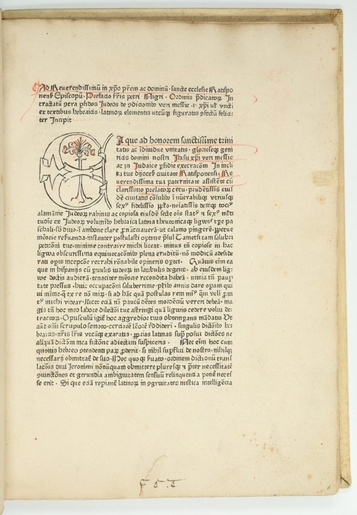
(“Treatise against the Treacherous Jews”), was intended primarily for a Latin-reading, predominantly clerical audience, later reaching a broader audience through its German edition of 1477.
LBI Library, r (f) 241
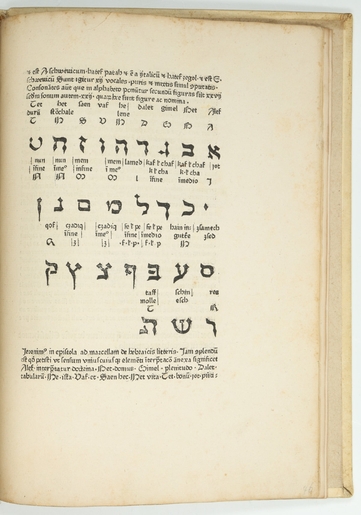
The work also contains a brief Hebrew grammar and features the earliest Hebrew characters in a printed book in Germany, those still produced through woodcuts or added by hand rather than movable type. Nigri learned Hebrew through contact with rabbis and Jewish communities. Ironically, despite his attacks on Judaism, Nigri’s Hebrew grammar remained a standard reference work until Johannes Reuchlin’s De rudimentis hebraicis appeared in 1506. LBI Library, r (f) 241
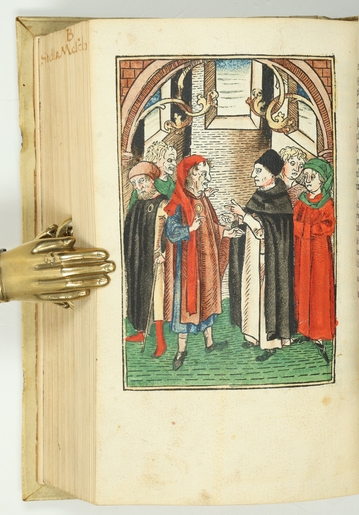
A revised and considerably expanded vernacular German version of Nigri's Tractatus contra perfidos Judeos, was published under the title Stern des Meschiah in 1477. This edition also includes some of the earliest printed depictions of contemporary Jews, reflecting Nigri’s participation in the week-long 1474 Regensburg Christian-Jewish disputation. The woodcut caricatures Jews with distorted features and expressions and depicts them wearing the compulsory yellow rotulus (ring), which marked Jews as outsiders in late medieval German society. LBI Library, r 1515
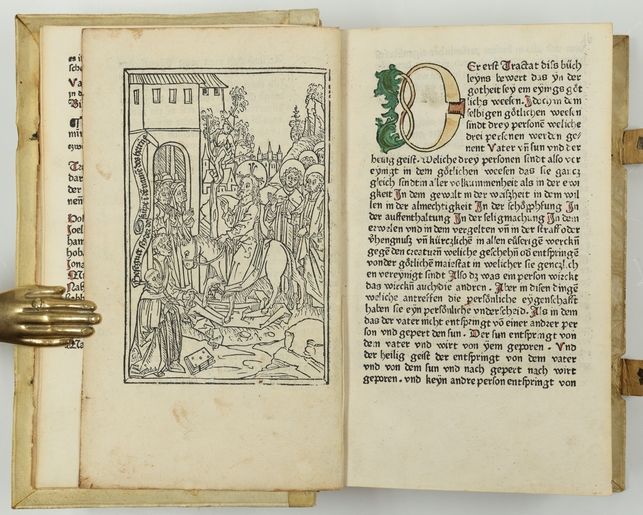
The second woodcut in the German edition depicts Christ entering the gates of Jerusalem; the opposite page, like many throughout the volume, features woodcut initials hand-colored in various hues. LBI Library, r 1515
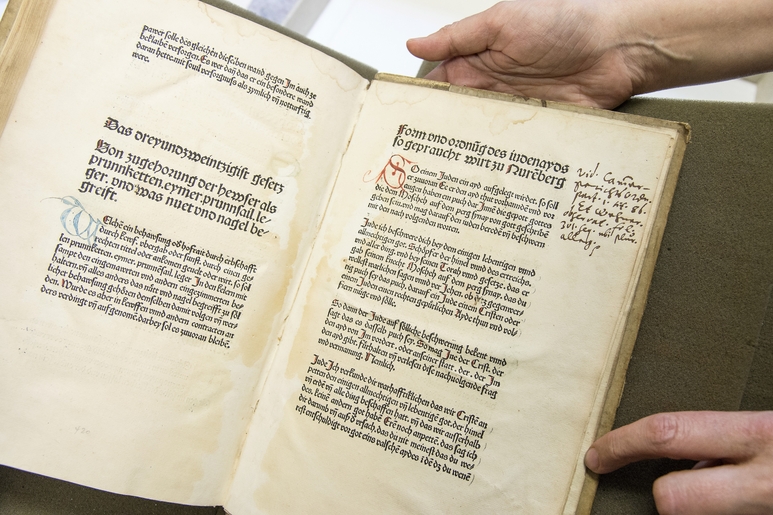
This influential Nuremberg law code from 1484, which included a Jewry Oath, sought to harmonize customary, canon, and Roman law and quickly became a model for other cities after the advent of print. The last pages contain regulations for administering a Jewry Oath. Since the medieval era, Jews had to take a special oath in certain court situations in many territories of the Holy Roman Empire. This was probably the first Jewry Oath ever to be printed. It became the dominant model for oath formulas for several centuries. LBI Library, r (q) DD 901 N94 R4. Photo: © studio k - kh krauskopf
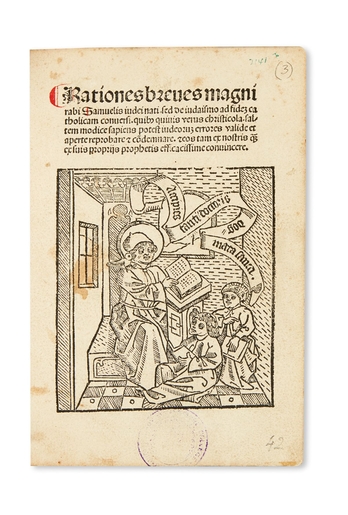
An early anti-Jewish conversion text attributed to the Dominican friar Alfonsus Bonihominis, who claimed to have translated it from Arabic. The work presents refutations of Jewish objections to Christianity attributed to the alleged Jewish convert Samuel Israeli of Morocco, though modern scholarship suggests that Bonihominis himself was likely the true author. LBI Library, r 1089
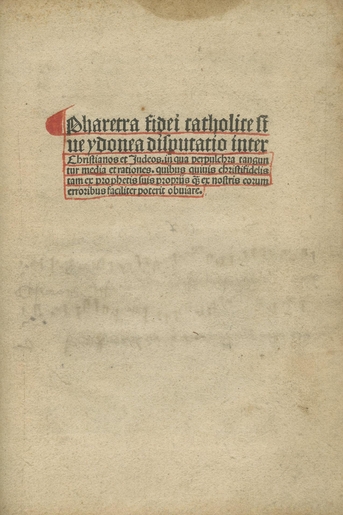
Part of the long tradition of Christian anti-Jewish polemical literature, this work presents a theological disputation between Christians and Jews intended to refute Jewish interpretations and affirm Christian doctrine. Based on earlier manuscript traditions connected to the 1240 Paris Talmud trial, it reflects the controversy that culminated in the burning of approximately 10,000 Hebrew manuscripts in Paris in 1242. The text circulated widely in both incunabula and early sixteenth-century editions. LBI Library, r 1389
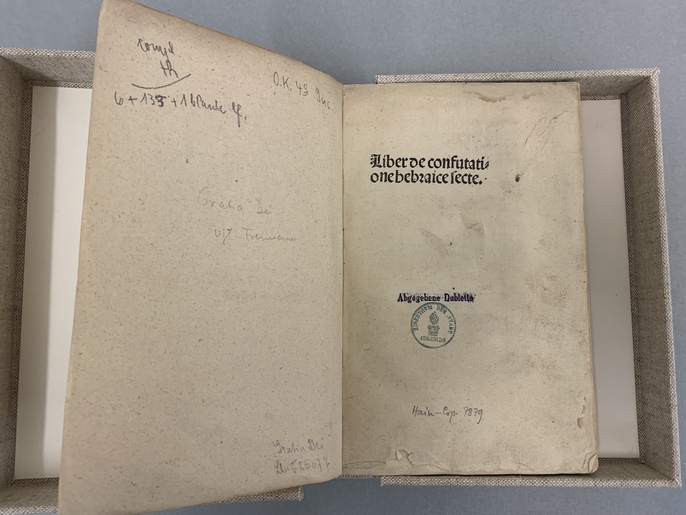
This work is attributed to the converted Jew Johannes Baptista Gratiadei, who presents a methodical refutation of rabbinic interpretations of the Book of Prophets. LBI acquired the volume in 1974; the stamp on the title page indicates that the book had been deaccessioned as a duplicate from the municipal library in Augsburg. LBI Library, r BM 585 G73.
Incunabula
Incunabula are books, pamphlets, or broadsides printed during the earliest phase of European printing, conventionally up to the year 1500.* The term derives from the Latin incunabula, meaning “cradle” or “swaddling clothes,” while the German equivalent Wiegendrucke carries the same sense of “cradle prints.”
Because printing was a brand new technology, incunabula often show a strong “transition” look to manuscripts. Early printers imitated the appearance of handwritten manuscripts. They often also left blank spaces for rubrication or hand-painted initials and illustrations to be added later. Early Incunabula often do not feature book elements such as title pages or pagination yet.
In their physical make-up, these books were typically printed on high-quality, thick rag paper or vellum and were often bound in heavy leather over wooden boards, frequently secured with metal clasp
Print runs of incunabula typically ranged from 200 to 500 copies, although larger and highly anticipated works, such as popular religious texts or Latin classics, could reach 1,000 or more. Because printing was still a new technology, production was carefully calibrated to expected demand in order to avoid financial loss from overproduction. A small number of copies, often around twenty per edition, were printed on parchment or vellum for wealthy buyers, while the majority were produced on paper. Historians estimate that about 35,000 titles, representing roughly 10 million individual volumes, were printed during the incunabula period. Of these early printed works, roughly 30,000 distinct editions are known to survive today (see ISTC) represented by an estimated 450,000 to 500,000 individual extant copies held in libraries and collections worldwide.
Incunabula in the LBI Library Rare Book Collection
The LBI Library Rare Book collection features six complete incunabula related to German Jewry printed in German lands between 1475 and 1500. These works include primarily Christian anti-Jewish polemical literature, alleged conversion accounts, and a legal text specifying the administration of the Jewish oath .
1) 1475: Petrus Nigri: Tractatus contra perfidos judeos. Esslingen, Konrad Fyner, 6. VI. 1475.
LBI Library r(f) 241 || GW M27101 || ISTC in00257000
2) 1477: Petrus Nigri: Stern des Meschiah. Esslingen, Konrad Fyner, Eve of St. Thomas [20 Dec.] 1477.
LBI Library r 1515 || GW M27104 || ISTC in00258000
3) 1484: Reformacion der Stat Nueremberg. 1484. Contains the Jewry Oath from 1484.
LBI Library r (q) DD 901 N94 R4 || GW M27333 || IST ir00037000
4) 1493: Rationes breves magni Rabi Samuelis. Cologne: Heinrich Quentell, 1493.
LBI Library r 1089 || GW M39861 ||IST is00110000
5) 1494/1500: Pharetra fidei catholice sive idonea disputatio inter Christianos et Judeos. Cologne: Heinrich Quentell, between 1494 and 1500.
LBI Library r 1389|| GW M45799 || ISTC ip00576000
6) 1500: Iohannes Baptista Gratia Dei: Liber de confutatione hebraice secte. Strassburg : Martin Flach, 1500.
LBI Library r BM 585 G73 || GW 11346 || ISTC ig00354000
Incunabula leaves in the LBI Collections
7) 1493: Several individual leaves from the The Nuremberg Chronicle are also part of the LBI Collections. The Nuremberg Chronicle (Liber chronicarum / Schedelsche Weltchronik) is a lavishly illustrated world history by Hartmann Schedel, published in 1493, that chronicles the history of the world from Creation to the Last Judgment, structured in seven ages. It is a landmark work of early printing, featuring nearly 2,000 woodcuts, including city views, biblical scenes, and portraits, and was a major community project funded by Nuremberg merchants.
- The murder of Simon of Trent, woodcut, 1493. LBI Collections 78.75
- Jerusalem, woodcut, 1493. LBI Collections, 78.76
- The Burning of the Jews, woodcut, 1493. LBI Collections, 78.73
- Biblical Scene, woodcut, 1493. LBI Collections, 78.74
- Danse Macabre, woodcut, 1493. LBI Collections, 78.1506a
Hebrew printing
Gutenberg’s invention of printing with movable type in mid-15th-century Europe enabled the start of the mass production of books, including his 1455 Bible, the earliest book printed from movable type in the Western Hemisphere. His press built on the design of the medieval press, itself derived from Mediterranean wine and olive presses, using a screw mechanism to apply pressure that transferred ink from type onto paper.
Hebrew printing emerged around 1470, with early activity centered in Italy, Spain, and Portugal. Its origins remain uncertain, as six undated editions, generally attributed to Rome and likely produced between 1469 and 1472, may predate the first dated Hebrew book.
That milestone, the first dated printed Hebrew book, came in 1475 with Rashi’s commentary on the Chumash/Pentateuch, printed in Italy, Reggio di Calabria, followed in the same year by the earliest known use of Hebrew characters in a printed Latin work, Petrus Nigri’s anti-Jewish treatise, Tractatus contra perfidos judeos, in Esslingen.
Hebrew incunabula were primarily produced in the Italian and Iberian peninsula, where printers developed distinctive Hebrew typefaces and established the foundations of Hebrew print culture. Excluded in many places from guild-based printing, Jewish typographers often cut their own type and drew on manuscript traditions, using square, Sephardic, and Rashi scripts. Several leading printers were of German origin, including the Soncino family, who became a major fifteenth- and sixteenth-century printing dynasty. In 1488, they produced the first complete printed Hebrew Bible with vowel points in Europe and issued influential editions of the Talmud and other rabbinic texts.
Early Hebrew books were initially printed without pagination and only gradually adopted signatures as a navigational system.
After the expulsion of the Jews from Spain in 1492 and from Portugal in 1497, Hebrew printing declined on the Iberian Peninsula but continued in Italy, and soon expanded into the Ottoman Empire, particularly Constantinople and Salonika, where exiled Iberian Jewish communities established important presses. In northern Europe, Hebrew printing began later, with the first Jewish press founded in Prague in 1512 by a group of Jewish scholars and scribes. In 1513, it was taken over by Gershon ben Solomon ha-Kohen, whose press developed into a major center of Hebrew printing in Europe. In other German lands, printing was largely driven by Christian Hebraists due to guild restrictions that limited Jewish participation. A 1511 Hebrew Psalms edition with David Kimhi’s commentary, printed in Tübingen by Thomas Anshelm, closely connected with the Christian humanist Johann Reuchlin, reflects the emerging role of Christian Hebraists in promoting Hebrew scholarship.
Despite technical challenges and censorship, Hebrew printing profoundly transformed Jewish textual culture. Printers worked under both ecclesiastical and Jewish communal oversight, with texts often requiring approval and sometimes being expurgated or suppressed. At the same time, growing Christian interest in learning Hebrew and in studying the Hebrew Bible ( referred to as the Old Testament), particularly in the context of the Protestant Reformation, created a significant non-Jewish market for Hebrew texts.
References
*The designation “incunabula” appears to have first been used in bibliographical scholarship in the 17th century. The commonly accepted cut-off date of 1500 remains a convention in modern bibliography rather than a reflection of a clear historical break. In practice, it is somewhat arbitrary, since there was no single technological or cultural shift in printing precisely at that date that would justify a strict boundary.
The principal databases for incunabula are the
Gesamtkatalog der Wiegendrucke, (GW) a monumental bibliographic project initiated in 1925 and still being compiled at the Staatsbibliothek zu Berlin, and, in the Anglo-American world, the
Incunabula Short Title Catalogue (ISTC), established in 1980 and hosted by the British Library. The ISTC incorporates Frederick R. Goff’s Incunabula in American Libraries as well as numerous other reference works.
“Hebrew Printing.” Jewish Virtual Library, 2008. Source: Encyclopaedia Judaica. https://jewishvirtuallibrary.org/hebrew-printing.
Jan-Hendryk de Boer. “ Die Differenz explizieren : Sprachformen gelehrter Judenfeindschaft im 16. Jahrhundert.” In Vernakuläre Wissenschaftskommunikation: Beiträge zur Entstehung und Frühgeschichte der modernen deutschen Wissenschaftssprachen, edited by Michael Prinz and Jürgen Schiewe. De Gruyter, 2018, 47-86.
Alexander Gordin. “Hebrew Incunabula in the National Library of Israel as a Source for Early Modern Book History in Europe and Beyond.” In Printing R-Evolution and Society: 1450-1500: Fifty Years That Changed Europe, edited by Cristina Dondi. Studi Di Storia. Venezia: Edizioni Ca’ Foscari - Digital Publishing, 2020.
Marvin J Heller. Essays on the Making of the Early Hebrew Book. Leiden: Brill, 2021.
Michelle Margolis. “History of the Early Printed Hebrew Book: Hebrew Incunabula.” Columbia University Libraries Subject & Course Guides, New York, 2019. https://guides.library.columbia.edu/c.php?g=869414&p=6240222.
Bruce Nielsen. “History of the Early Printed Hebrew Book: Hebrew Incunabula.” Penn Libraries: Guides, Philadelphia, PA, 2024. https://guides.library.upenn.edu/c.php?g=468836&p=3212491.