New Acquisitions Strengthen LBI Rare Book Collection
- Author
- Renate Evers
- Date
- Thu, Sep 24, 2026
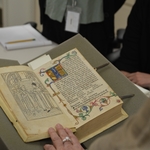
The Leo Baeck Institute Library is pleased to announce the acquisition of two remarkable fifteenth-century printed books, or incunabula, further strengthening the Institute’s distinguished Rare Book Collection. Printed before 1501, incunabula represent the earliest decades of European printing and offer an unparalleled window into the intellectual, religious, and cultural transformations that accompanied the invention of movable type.
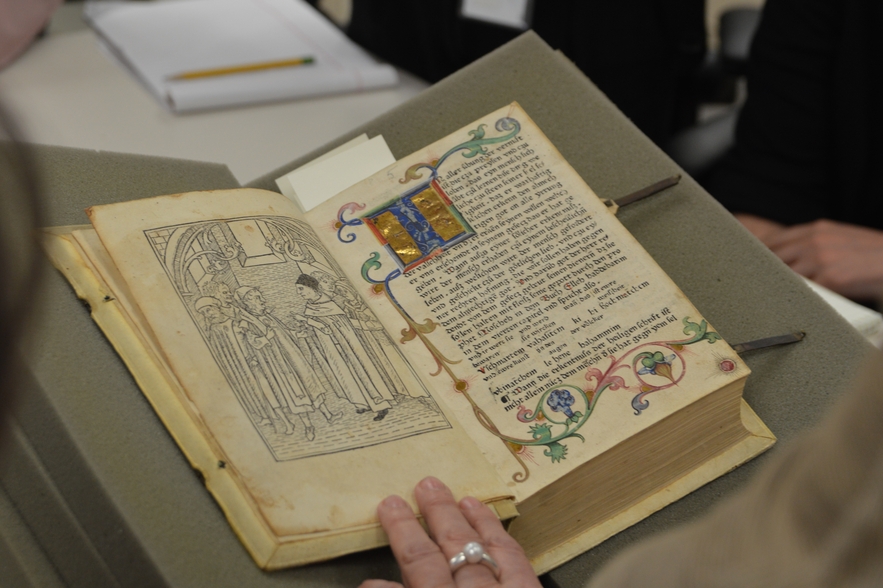
The two new acquisitions are the 1475 Latin edition and the 1477 German edition of an anti-Jewish polemical work by the Dominican friar Petrus Nigri (Peter Schwarz). A missionary preacher and polemicist, Nigri engaged in sermons and public disputations aimed at converting Jews. Together, these volumes are among the earliest printed books relating to Jews produced in the German-speaking lands and provide extraordinary evidence of the complex and often contentious relationship between Christian and Jewish communities at the dawn of the age of print.
The earlier of the two volumes, Tractatus contra perfidos Judeos (“Treatise against the Treacherous Jews”), was printed in Esslingen in 1475. Intended primarily for a learned Latin-reading audience of clergy and theologians, the work sought to provide arguments for the conversion of Jews through theological disputation.
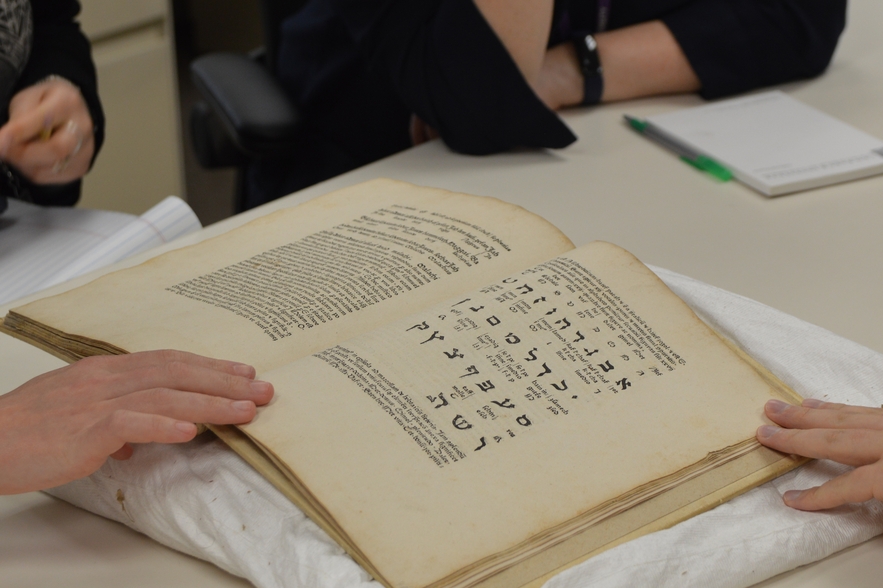
Beyond its polemical content, the volume is remarkable for another reason: it contains a brief Hebrew grammar and features the earliest known Hebrew characters featured in a book in the German lands. At this early stage of printing in German lands, the Hebrew letters were produced from woodcuts or added by hand rather than set in movable Hebrew type. Nigri acquired his knowledge of Hebrew through contact with rabbis and Jewish communities in Spain, Italy, and France. Ironically, despite his vehement attacks on Judaism, his Hebrew grammar remained a standard reference work for decades, until Johannes Reuchlin’s groundbreaking De rudimentis hebraicis appeared in 1506.
Today, these images serve as powerful historical evidence of the prejudices and intellectual and visual propaganda that shaped Christian perceptions of Jews during the late Middle Ages.
Although both works were written as anti-Jewish polemics, they are invaluable primary sources for understanding the religious, social, and cultural history of medieval Europe. They document not only Christian missionary efforts and theological debate but also the emergence of Hebrew studies within Christian scholarship, foreshadowing the Reformation, the earliest use of Hebrew in printing in the German lands, and the development of printed visual culture.
The acquisition of these two incunabula underscores the Leo Baeck Institute’s commitment to preserving the full spectrum of German-Jewish history, including sources that bear witness to anti-Judaism and religious conflict. By making these rare books available to scholars, students, and the public, LBI ensures that they continue to inform research into the origins of printing, Jewish-Christian relations, and the history of the book.
From LBI News No. 122 (Fall 2026)