Marianne Rein's Europa
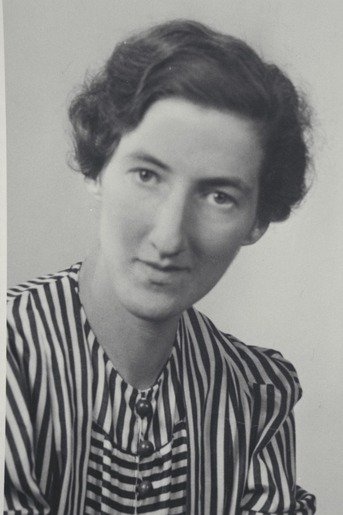
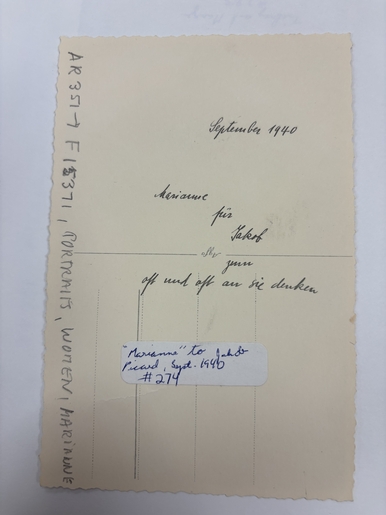
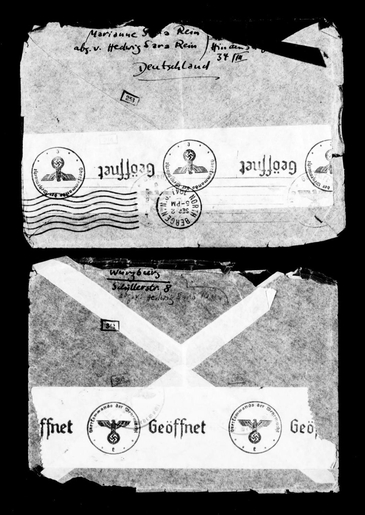
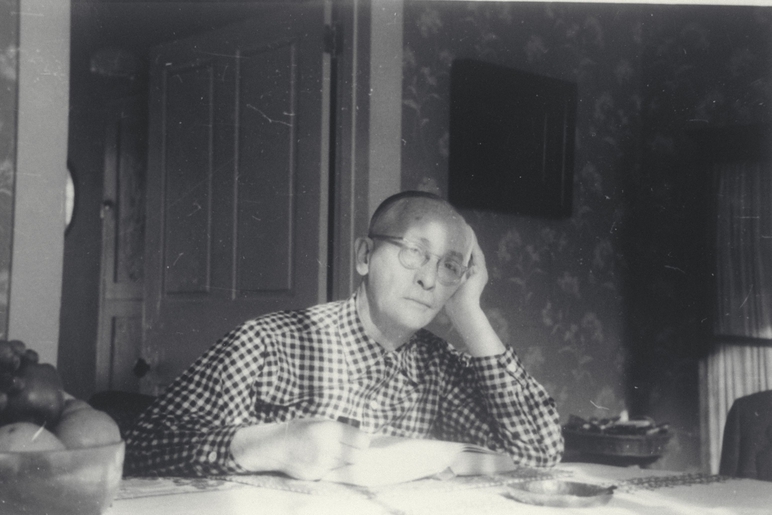
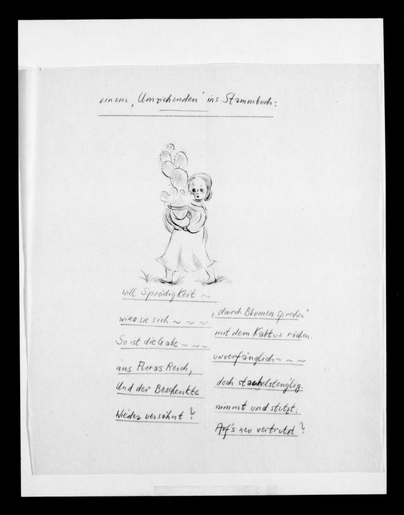
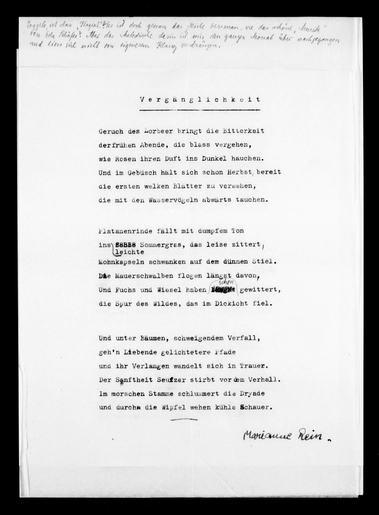
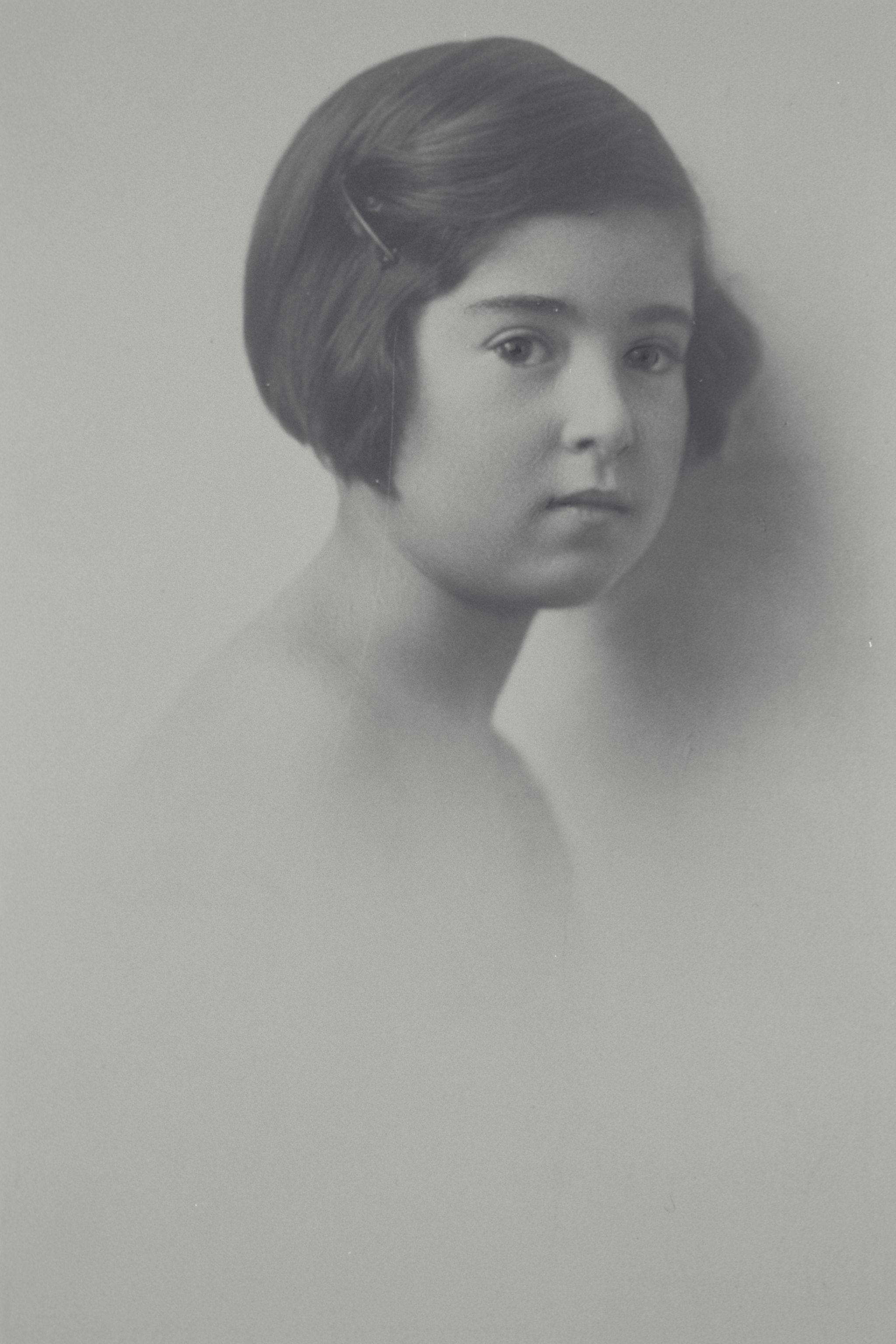
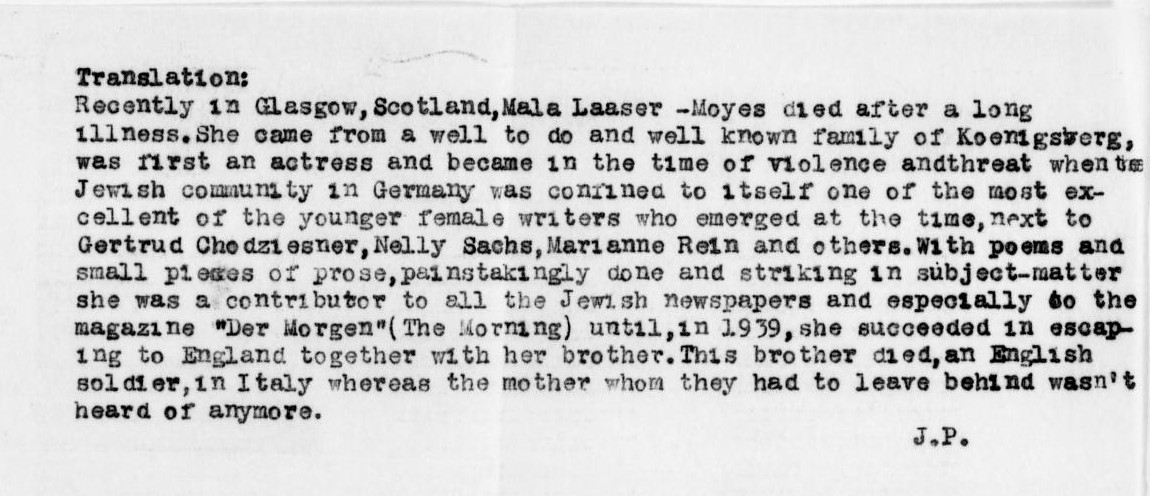
Marianne Rein was born in 1911 in Genoa, where her father was occupied as a merchant. After her father's death when she was six, Marianne returned with her mother to Würzburg, where her relatives from the well-known Schwabacher family lived. It was here she spent the rest of her life. She attended a Jewish girls' school and became interested in literature and writing. With the support of her mother’s family, Marianne grew up in a comfortable home and was able to start her own career as a writer. As a young woman, she was soon having poems published in various small journals, in addition to the popular Jewish journal Der Morgen.
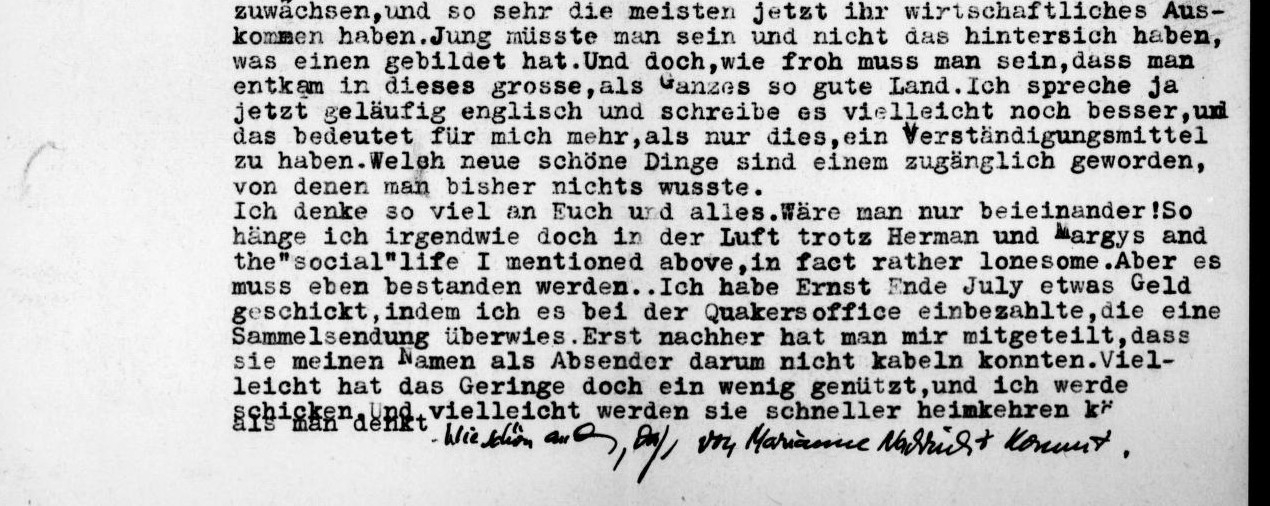
It is with thanks to the Leo Baeck Institute Archives we know so much about her and her work today. Marianne was acquainted with Jacob Picard, a Jewish lawyer who had also started a career as a poet. As things worsened in Germany, Picard managed to flee Germany in 1940 and start a new life in New York. From 1938 to 1941, Marianne wrote him numerous letters, with an abundance of prose and poetry she authored folded into the envelopes. Picard saved these letters and eventually this body of correspondence was donated to the Leo Baeck Institute Archives, where the letters, prose, and poetry can be found today. The poems in this correspondence sent to Picard provide the largest body – indeed, for all practical purposes the only body – of her poetry still surviving today.
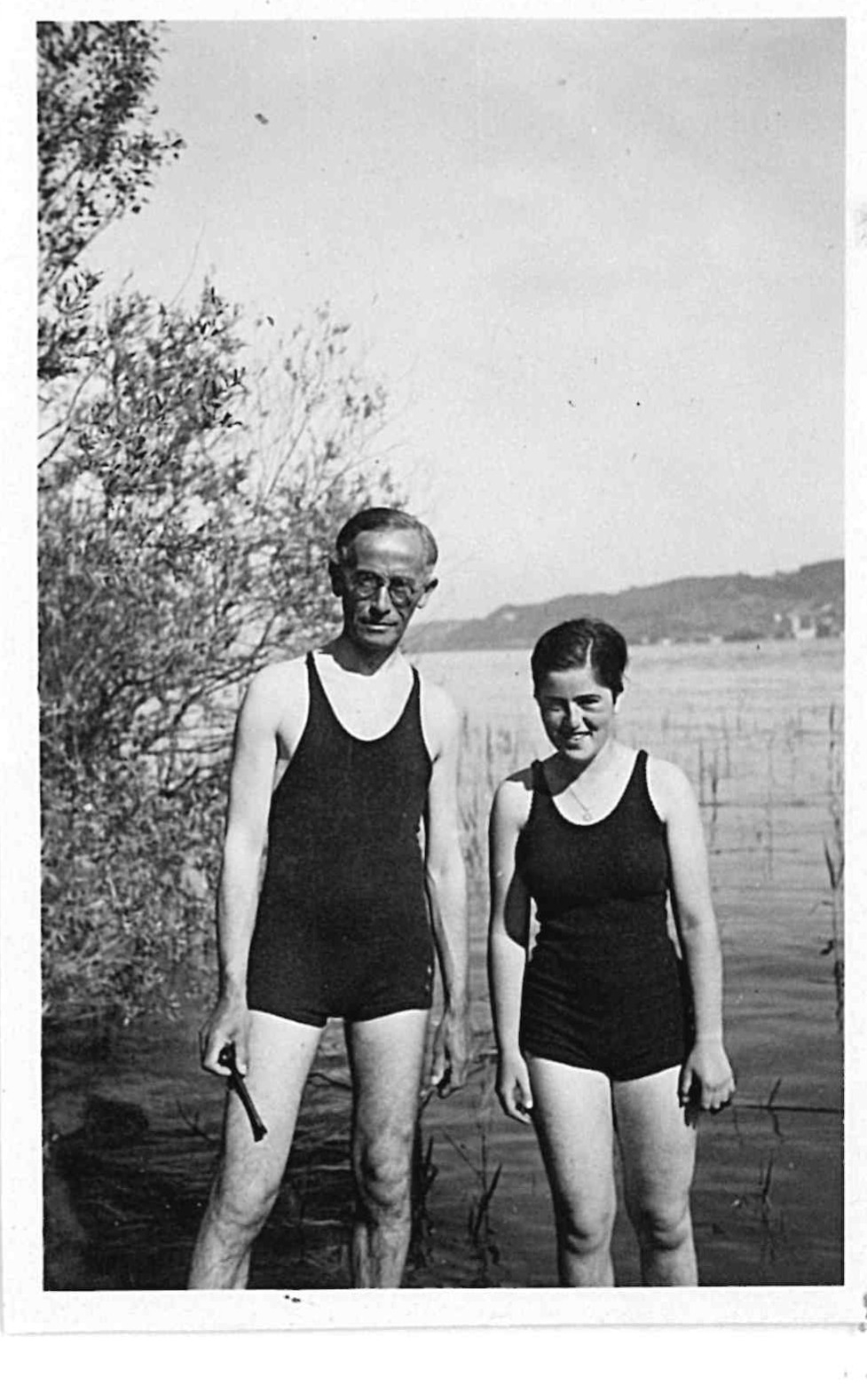
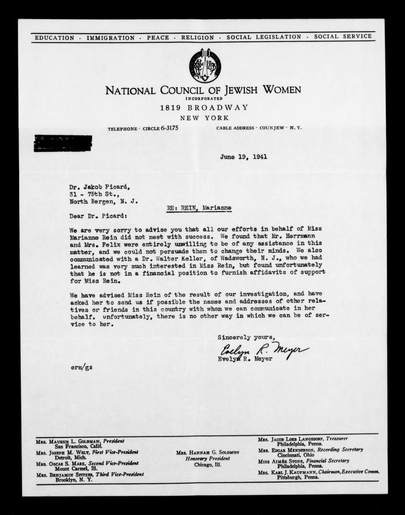
Marianne wanted to escape Germany, though she worried about her mother. Marianne was unmarried and lived with her mother, for whom she cared. Attempts to flee together and start over elsewhere proved futile, and eventually Marianne, being much younger and with a better chance of escape if she went alone, worked with Picard and presumably others to try and reach safety. Letters between Marianne's cousin in Brooklyn, Lore Oppenheimer, and Jacob Picard show their discussions regarding immigration fees, as well as the difficulties they had obtaining visa for Marianne.
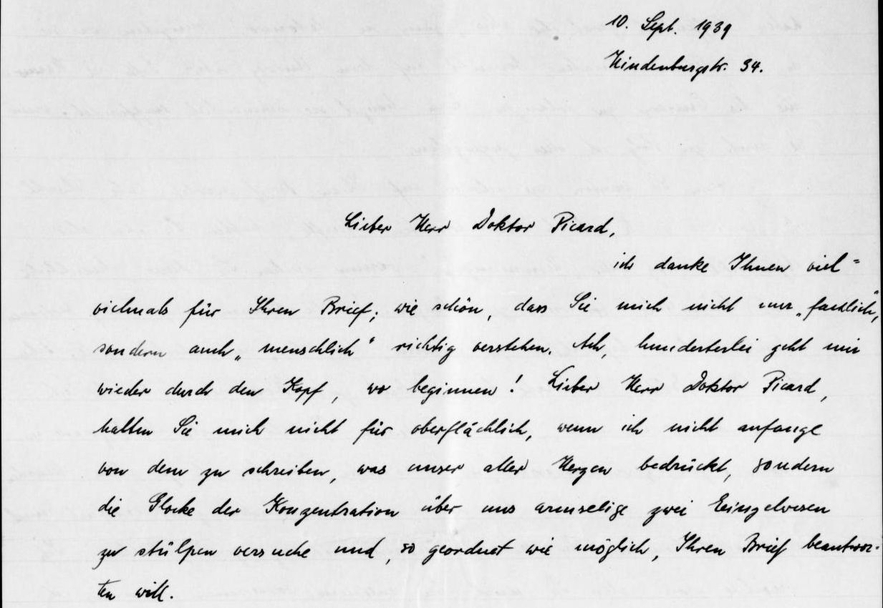
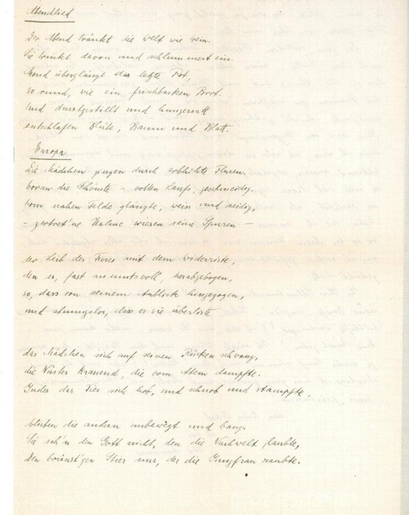
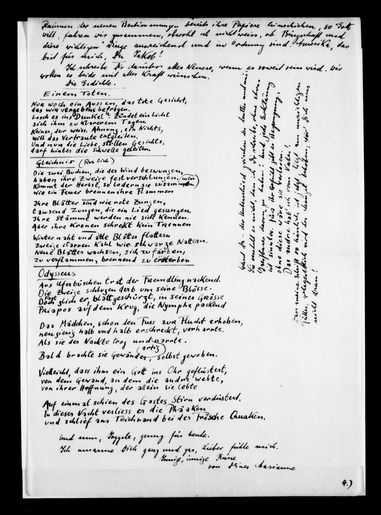
During the 1930s and into the early 1940s she continued to write as well. She was greatly influenced by the beauty and power of nature – the sky, flooded rivers, forests, fields, and animals all come into play. Some of her poetry takes on classical motifs, such as her poem “Europa,” one of those found at the Leo Baeck Institute letters to Picard. You can see the original sent to Picard in the photograph carousel at the top of the page, and we provide here a translation. The poem describes the abduction of the maiden Europa by Zeus in the form of a bull.
Europa
The girls walked through the blooming landscape.
Following the most beautiful one — fast but smooth.
Not far away he glowed, white and mellow,
— scrunched blades of grass revealed his track —
the animal’s body with the neck,
with which it, almost gracefully, bent down,
so that, magnetized by his stature,
and innocent of knowing that he had outflanked her,
the beautiful girl swung on his back,
the nostrils crawling and steaming from his breath.
Meanwhile the animal arose, and snorted and stamped,
while the other girls were stagnant and afraid.
They did not see the god future generations believed in,
they only saw the bull that stole the virgin.
(Poem translated from the German by Meike Bingemann and Michael Simonson, Leo Baeck Institute).
The poem captures the power of Zeus as the bull, but also describes how Europa embraces him – a force of nature, of sexuality, a God, but also threatening in his outflanking of her, providing no escape. The other maidens huddle behind, afraid and unable to recognize the bull for what it really is.
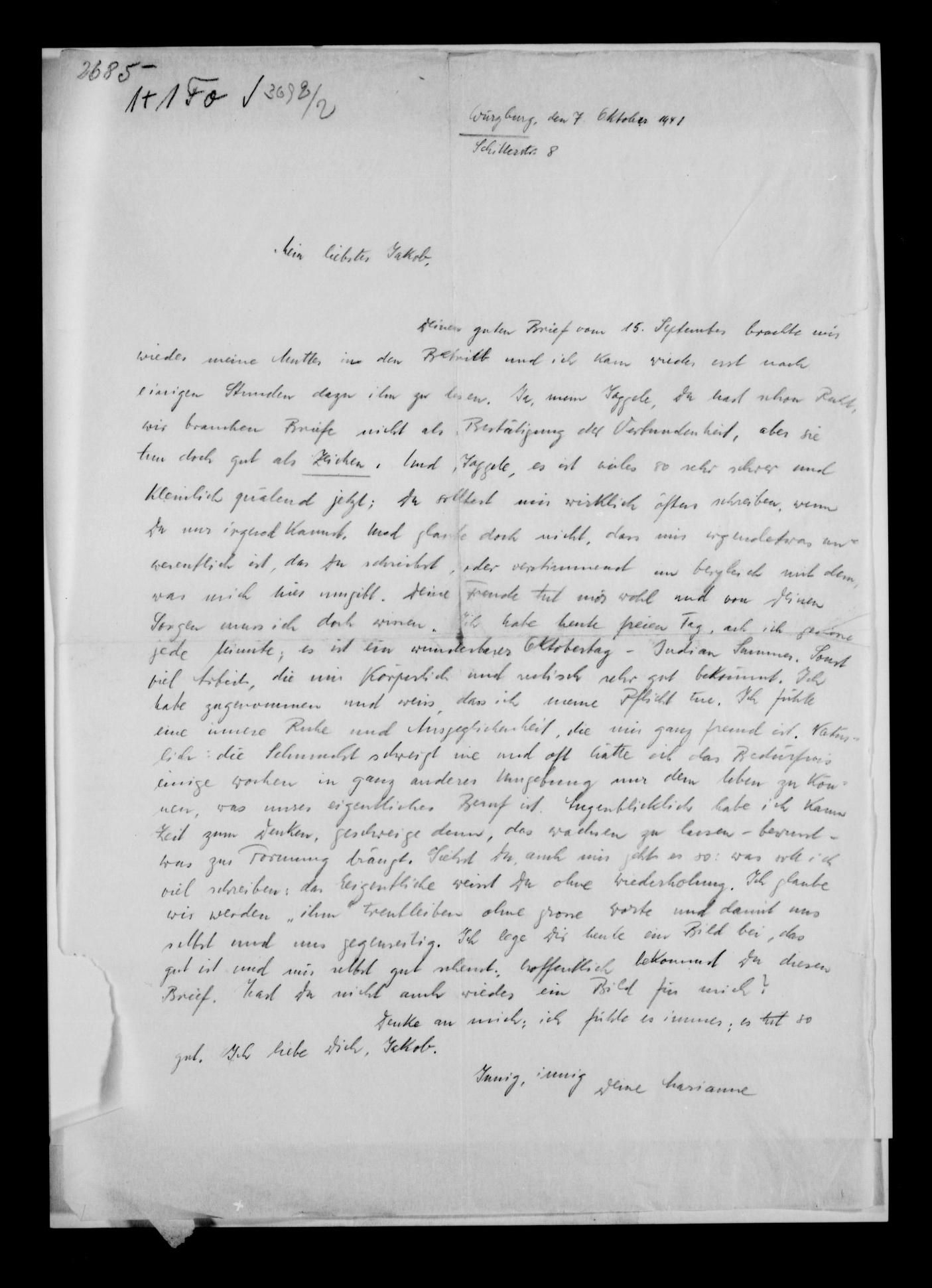
Jacob Picard worked to get Marianne out of Germany. A letter in the carousel above, found in the collection, shows a failed attempt tried with help from the National Council of Jewish Women in the United States. For Marianne and her mother, life worsened as Nazi laws took increasing effect. Eventually they had to move into a small living space in a building reserved for Jews, and Marianne started working at the Jewish hospital in Wurzburg. She found this work exhausting, in that it took away the space and quiet she so desired to focus on her poetry. In October 1941 she wrote in a letter to Picard, “
“Today I have off, and I enjoy every minute of it. Oh, it’s a beautiful October day — Indian Summer. Otherwise there is a lot of work physically and mentally…..I feel an inner peace and balance, which is quite alien to me. Of course, the longing for silence never ends and I need several weeks in a completely different environment to live for what is my real job (writing). At present I have no time to think, let alone to let my growing consciousness be molded and formed…”
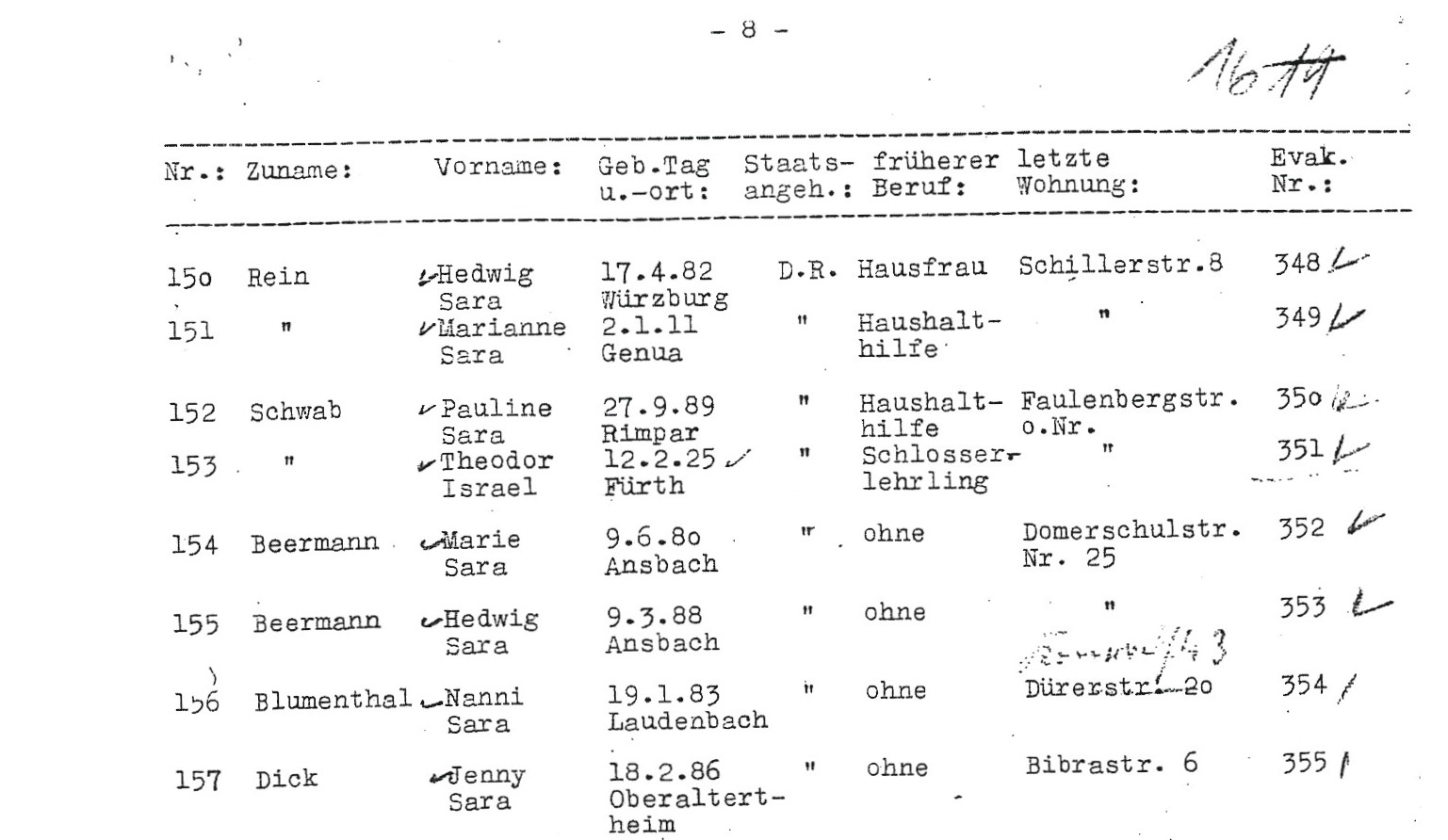
In November 1941, Marianne and her mother were among the first Jews deported from Würzburg. With 200 other people they were sent to Nuremberg, where they joined a larger transport to the Riga Ghetto. Both were murdered there, their exact fates unknown.
In 2011, a book of Marianne Rein's poetry was published by the Egon Verlag, edited by Rosa Grimm. The Leo Baeck Institute is pleased to have a copy of this volume in its library collections, an accompaniment to the handwritten or typed originals in the Jacob Picard Collection.
Sources:
Bosch, Manfred. Jacob Picard, 1883-1967: Dichter des süddeutschen Landjudetums. Wangen : Freundeskreis Jacob Picard, 2017.
Grimm, Rosa. "Wer war Marianne Rein?" Gesellschaft für christlich-jüdische Zusammenarbeit in Würzburg und Unterfranken e. Viewed online April 22, 2021
Rein, Marianne Dora. Marianne Dora Rein: Das Werk. Edited by Rosa Grimm, with Kai C. Moritz, Ergon Verlag, 2011.
Raim, Edith. "Marianne Rein : eine vergessene jüdische Dichterin aus Würzburg." Mainfränkisches Jahrbuch für Geschichte und Kunst. Band 59 (2007) Würzburg : Freunde Mainfränkischer Kunst und Geschichte, 2007.
Updated April 13, 2026.